

Old Tank Removal
The existing tank is drained, disconnected and hauled away when you ask for removal.
Switching from a tank to a tankless water heater usually means changes to the gas line, venting, drainage or electrical supply. We connect homeowners with independent, licensed local installers who can scope the conversion before any work begins.
Converting from a tank to tankless changes piping, venting and utilities, so here is what a complete conversion from a licensed installer should include.
The existing tank is drained, disconnected and hauled away when you ask for removal.
The new unit is sized by gallons per minute so it matches your household's peak demand.
Gas piping is checked and upsized where needed, since tankless units draw more at once.
The old tank vent is replaced with venting rated for the tankless unit and its location.
Water lines are rerouted to the new spot, with service valves added for future descaling.
The installer pulls the permit where required and the conversion is inspected to code.
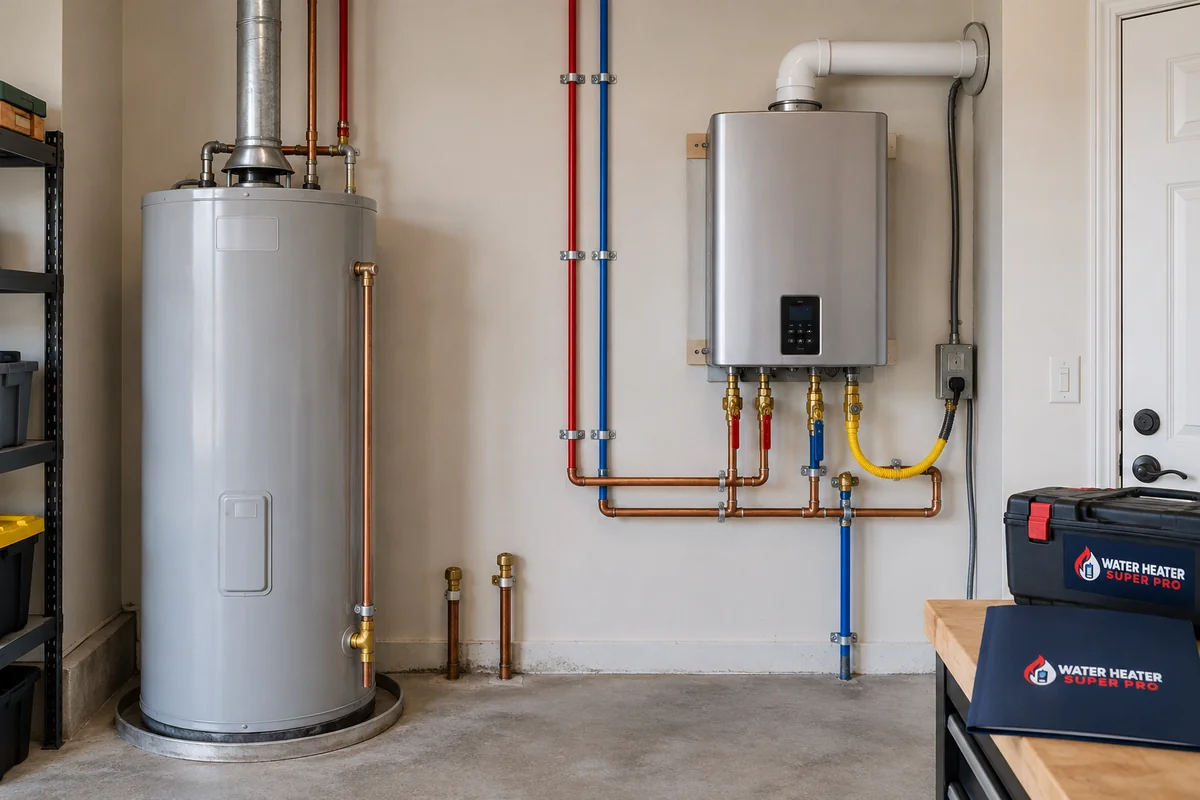
Most tank to tankless conversions follow one of three paths, depending on your current fuel and where the new unit will be mounted.
Homes already on natural gas utility service
Electric tank homes with gas service available
Homes without gas that want endless hot water
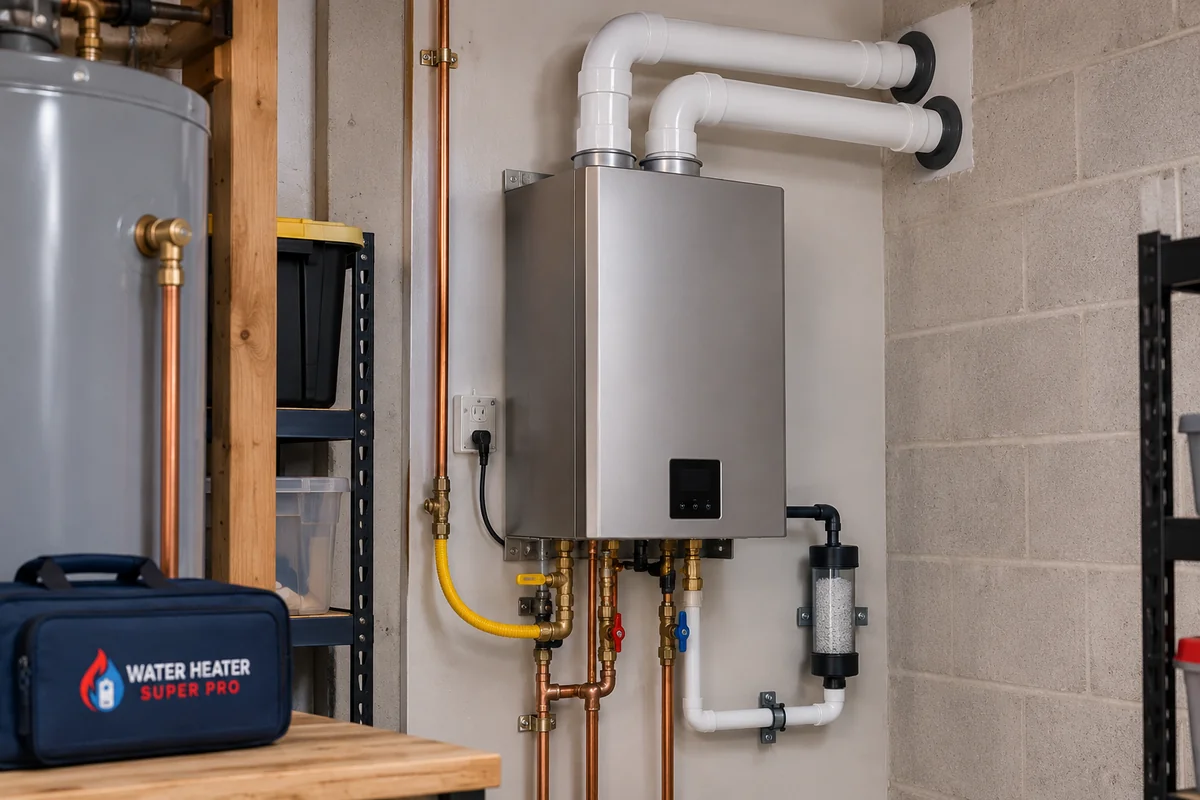
Conversion estimates vary more than straight replacements, and these five factors explain most of the difference between written quotes from installers.
| Factor | Why it changes the estimate |
|---|---|
| Current fuel type | Staying on gas reuses some work, while switching fuels adds new gas or electrical service. |
| Gas line capacity | A line sized for a tank often cannot feed a tankless unit, so pipe to the meter may change. |
| Venting changes | Tank flues usually cannot be reused, so new vent pipe and a new wall or roof exit are added. |
| New unit location | Moving the unit to an outside wall or garage means rerouting water, gas and condensate lines. |
| Electrical upgrades | Electric tankless units can need several large breakers, heavier wire or a panel upgrade. |
Tell us about your current tank, fuel type and goals in the short form on this page.
We match you with an independent licensed installer who covers your ZIP code.
The installer checks gas, venting and power, then gives you a written estimate.
Compare the estimate on your own time and choose what to do, with no obligation.
One form starts one tank to tankless conversion request: a single matched installer, an itemized written estimate and no cost to compare it with other quotes.
Your request goes to an installer who handles tank to tankless conversion projects.
Installers in our network hold the state license the work requires in your area.
Ask for removal, the unit, gas, venting, permit and labor listed line by line.
Requests go to independent licensed installers who cover your ZIP code and area.
Key facts from this page, one line each.
A tank-to-tankless conversion replaces a tank water heater with a tankless water heater that has different gas, venting, drainage and electrical needs. A tank swap reuses existing connections; a conversion often replaces or upgrades them. That extra scope is why conversions need an on-site assessment before a firm estimate.
Before deciding, confirm that tankless matches how your household uses hot water. Our tankless water heaters overview explains sizing and the trade-offs against a tank.
Gas line capacity is often the first conversion question, because a gas tankless water heater can require much more gas input than the tank it replaces. The installer must check pipe size, length and the combined demand of the furnace, range and other gas appliances. An undersized line can cause poor performance or ignition errors.
Propane systems need the same check on the regulator and tank supply.
A gas line upgrade for a tankless conversion usually means a larger pipe run from the meter to the new unit. The installer sizes the new pipe for the tankless unit's maximum input plus every other gas appliance, so the burner gets enough fuel when the furnace and range run at the same time.
A gas meter evaluation is sometimes needed when the total household gas demand rises after a tankless conversion. The installer will tell you whether the meter or service should be reviewed with your gas utility, and that step should appear in the estimate as a separate item rather than an assumption.
Venting for a tankless water heater must follow the manufacturer's instructions for pipe material, length, number of elbows and termination clearances, so an old metal tank flue is generally not reusable. Condensing tankless units also produce acidic condensate that needs a drain route, often through a neutralizer, to an approved location.
Ask the installer to show the planned vent route and termination point on site, so you know where the new pipe will exit the house.
A new tankless vent route usually exits through a side wall or the roof in manufacturer-approved pipe, with clearances from windows, doors and air intakes. Condensing models often allow PVC or CPVC, while non-condensing models need heat-rated vent material, which affects both the route and the scope of the conversion.
A shared chimney can change how it drafts when the old water heater is removed, because the furnace is left venting alone into a flue sized for two appliances. Ask the installer whether the furnace venting will be checked as part of the tank-to-tankless conversion and what happens if it needs work.
A gas tankless water heater still needs electricity for the control board, ignition and combustion fan, so a conversion usually needs a nearby outlet or circuit. Because scale is the main threat to a tankless heat exchanger, the conversion is also the right time to plan water treatment and isolation valves for future descaling.
Homes with hard water may benefit from a scale-reduction system recommended by the manufacturer. Our tankless water heater maintenance page explains descaling and inlet filter care. Whole-house electric tankless conversions are a different project that usually requires several high-capacity circuits and a load check.
A tank-to-tankless conversion estimate must list the model and its GPM at your temperature rise, gas line work, vent material and route, condensate drain, electrical work, isolation valves, water treatment if any, relief valve, old tank removal and the permit. Missing items are where surprise charges come from.
Compare estimates line by line rather than by total alone.
Ask about any line that is missing before you sign. Our tankless water heater cost guide explains what drives the price, and you can request an estimate to have a licensed local installer scope your home.
A permit for a tank-to-tankless conversion depends on jurisdiction and scope, and conversions that add gas, venting or electrical work typically involve more review than a straight swap. Permits and inspections are handled by your local building inspections office, which sets its own requirements. Licensed installers typically pull the permit.
See our guide to choosing a water heater installer for what to ask about permits and licensing.
A conversion estimate depends on your current fuel, gas line capacity, new venting, the unit's GPM, any change in location, electrical upgrades, old tank removal and the permit. Conversions usually involve more work than a tank swap. A licensed installer assesses your home and gives you a written, itemized estimate to review.
Converting from a tank to tankless yourself is not recommended. The job usually changes gas piping, venting, combustion air and sometimes electrical service, all of which must meet the manufacturer's manual and local code. Permits are often required and are handled by your local building inspections office. A licensed installer typically pulls the permit.
A tank to tankless conversion usually costs more up front than a tank replacement because gas lines, venting or electrical service often change. Tankless units also need periodic descaling, and a short burst of cooler water can occur when demand starts. Correct sizing and maintenance keep these trade-offs manageable for most homes.
Yes, when the unit is sized for it. Add the flow rates of the showers and fixtures you run at the same time, then match that total to the unit's GPM rating at your winter temperature rise. Homes with high demand sometimes use two linked units. The installer confirms sizing during the assessment.
Size depends on how many fixtures run at once, not only the bathroom count. A home with four bathrooms may need a high GPM unit or two linked units if several showers run together in winter. The installer measures your peak demand and incoming water temperature, then recommends a size in the written estimate.
A cold shower usually means the unit is undersized for the demand, the gas supply is too small, scale has built up in the heat exchanger, or the inlet filter is clogged. During a conversion, correct GPM sizing and gas line sizing prevent most of these problems. Regular descaling handles the rest.
Open the service area directory, pick your city and you land on tankless water heater installation for that city: what the job includes there, who issues the permit and how to get a free written estimate from a licensed local installer.
Or browse by state: North Carolina · South Carolina
Share your ZIP code and the problem. A licensed installer covering your area follows up with a written estimate.